Engaging with storytelling, whether in the classroom or in other social situations, requires us to not only be willing to share our personal stories, but to reach out to others for accounts of their experiences. As we remember to consider multiple viewpoints on life’s most challenging aspects, we will see that stories are an essential component of discourse or debate.
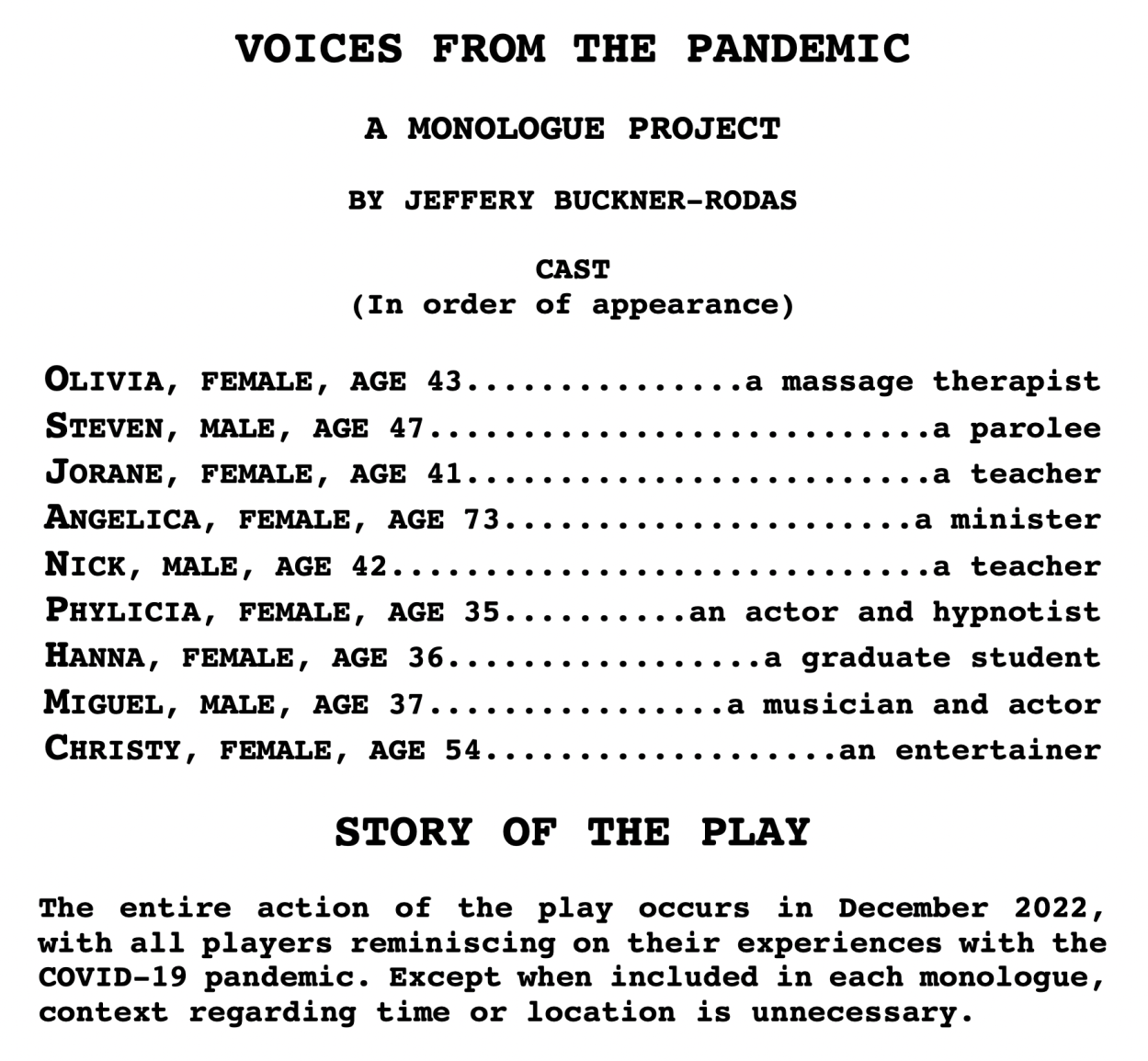
The purpose of this monologue project, inspired by the work of Ann Frkovich and Annie Thoms (2004), is to bring together multiple voices and experiences of the COVID-19 pandemic. As the pandemic is universally present in our recent daily lives, to one degree or another, I believed it to be worthwhile to discover unique narratives that will offer insights not available in broader contexts.
A monologue project is essentially a collection of accounts based on transcripts of interviews. I reached out to nine people with varying ages, cultures, and backgrounds. I have made the individual interviews available in audio and transcript forms, as well as the collection of extracted monologues I have titled Voices from the Pandemic: A Monologue Project. Much of my work for the Story as Pedagogy project is linked to process drama, so I offer this as another example of how to use drama in the classroom as a way to help learners develop empathy and understanding of others by engaging with their personal stories.
Below, you will find links to the various audio and textual files, as well as the finished manuscript. The various files can be used as an example of how students can take a story from audio, to a transcript, and then to a polished, but still authentic representation of true human experiences. The transcripts will help you to see what questions I asked my participants and what order I asked them. I designed the questions in a way to allow for interviewees to discuss various aspects of their experiences, some that are positive and inspiring and some that are difficult and tragic.
Once I had all of the interviews edited to their current forms, I was able to find connections, similarities, and differences in the stories that could be mixed together to form a unified story. Many of the personal accounts were too long to work as monologues, so they were redacted to an appropriate length while maintaining the integrity of their accounts. You will see that the audio and transcriptions include fillers (umms, ahhs, etc.), because I do not see these as meaningless, but as indicators of the feelings behind spoken words. I did, however, omit the vast majority of those fillers in the extracted monologues. If you choose to try this type of work in your classroom, you can make decisions on how you want your students to represent the stories they collect in their various forms. Please contact me by email at jefferybuckner@gmail.com if you have any questions about this process.
olivia: transcript Audio
Stephen: transcript Audio
Jorane: transcript Audio
Angelica: transcript Audio
Nick: transcript Audio
PhylicIa: transcript Audio
Hanna: transcript Audio
Miguel: transcript Audio
Christy: transcript Audio
VOICES FROM THE PANDEMIC MANUSCRIPT
Ann Frkovich & Annie Thoms. (2004). The Monologue Project for Creating Vital Drama in Secondary Schools. The English Journal, 94(2), 76-84. https://doi.org/10.2307/4128778
 Story-Based Pedagogy