Image: Canva Pro
The phrase Narrative Medicine was coined by Rita Charon, a medical doctor who also earned a Ph.D. in English. She recognized the power of storytelling to help healthcare professionals connect and empathize with patients. While it is used mostly in the helping professions, the practice of narrative medicine does not require medical training and does not involve therapy; rather, in this approach, writing and creative practices are used to help people connect to each other in a variety of professional settings. Today, there are several formal training programs in narrative medicine around the country and internationally. Some offer facilitation training, while others offer certificates and formal degrees in the approach. Burnett, Leoson, and Buckner-Rodas completed Narrative Medicine Facilitation Training through the Northwest Narrative Medicine Collaborative and utilize the principles of narrative medicine to connect and empathize with students.
The three of us felt narrative medicine added depth to our projects. Though the focus of this exploration is medicine, in the narrative medicine field, medicine means the human body, mind, and soul. Our lessons in narrative medicine facilitator training led us into deeper examinations of empathy, nurturing, mental wellness, and connection. For a more in-depth discussion of narrative medicine and its connection to story-based pedagogy, please listen to episode four of our podcast, “Teaching With Story.”
Examples of Narrative Medicine Activities:
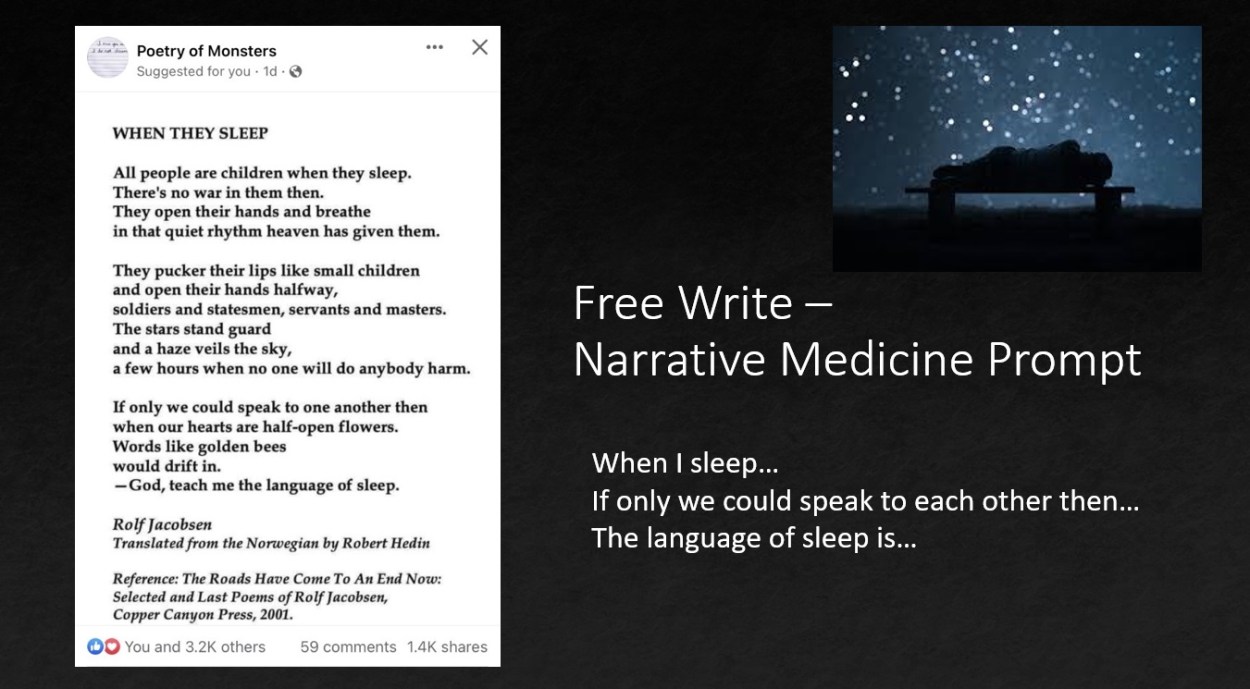
Third Objects & Prompts


Professional Development Opportunities
Northwest Narrative Medicine Collaborative – Facilitation Training
Columbia University – Professional Development Certificate & Master’s Degree
University of Toronto – Interprofessional Health, Arts & Humanities Certificate
Additional resources
We have cultivated sources shared with us during our facilitator training that encompass the spirit of narrative medicine, help to define it, and explore the connection between storytelling and empathy and connection.
What To Do With Stories: The Sciences of Narrative Medicine by Rita Charon
Why Storytelling is Part of Being a Good Doctor by Jerome Groopman
The Habits of an Improver by Bill Lucas and Hadjer Nacer
An investigation into the efficiency of the “third object” lessons from narrative medicine in the form of art. More than visual literacy: art and the enhancement of tolerance for ambiguity and empathy by Miriam Ethel Bentwich and Peter Gilbey.
© 2023 by Mary Leoson, Finnian Burnett, & Jeffery Buckner-Rodas
 Story-Based Pedagogy