Image: Canva Pro
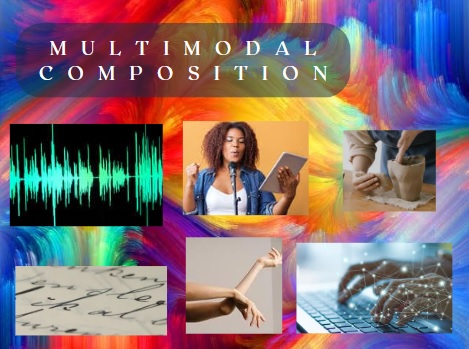
Multimodal composition refers to projects in which students use multiple modes of expression when communicating ideas, including combinations of written language, spoken language, visuals, audio, tactile, gestural, and spatial forms (Kress, as cited by Cope & Kalantzis 176). In recent years, this type of project has gained the most traction among English composition instructors but the conversation about integrating it into creative writing classrooms is widening. Multimodal projects can help students develop skills in the areas of audience and purpose, narrative function, conceptual organization, and relational learning (Lemerone 2, Stukenberg 1-2). Stukenberg suggests that when composing multimodal pieces, students “make decisions about combinations, prompting more thinking…about metaphor…and juxtapositions between elements” (5). Thus, such projects engage students in higher-order thinking while also recognizing the inherent value in creativity as a human quality (Stukenberg 1).
This paragraph also appears in Leoson’s Literature Review and Theoretical Foundation
It is also important to recognize that, while most instructors intend multimodal projects to be inclusive, to appeal to multiple intelligences, and to provide students with a variety of creative options, teachers must plan for potential student accommodations. Thus, there should be room for adapting assignments and rubrics for those with visual, auditory, physical, or other types of impairments.
For more information about how the concept of multimodal composition was developed, see Leoson’s Literature Review and Theoretical Foundation (under the Rethinking the Writers’ Workshop link) and her video Co-Creating Dynamic, Brave Learning Spaces at 12 minutes, 48 seconds.
For a more in-depth discussion of multimodal composition and its connection to story-based pedagogy, please listen to episode two of our podcast, “Teaching With Story.”
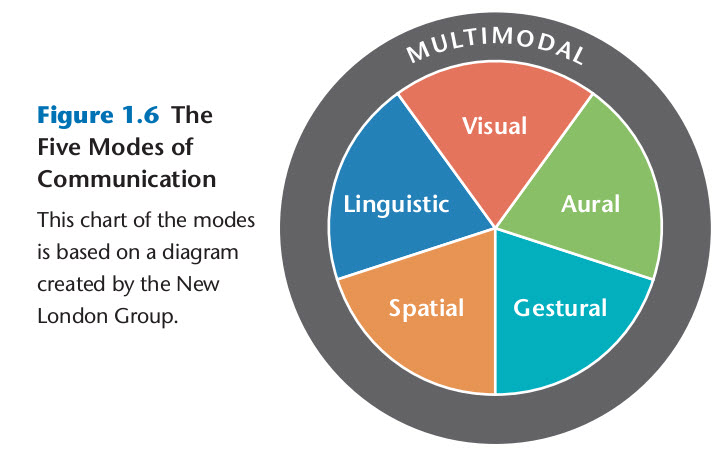
Image: Lumen. English Composition 1. Accessed March 16, 2023, https://courses.lumenlearning.com/englishcomp1/chapter/the-five-modes/

Image: Canva Pro
Resources
Cleveland State University’s Research Guide on Multimodal Composition
Boston University’s Multimodality in the Writing Classroom
The University of Michigan’s Multimodal Composition Resource
Also be sure to check out the resources listed under The Power of Story page.
An Introduction to and Strategies for Multimodal Composing by Melanie Gagich (Mary’s colleague at CSU)
Book – Toward a Composition Made Whole
Book – Writer / Designer: A Guide to Making Multimodal Projects
Book – Multimodal Composition: A Critical Sourcebook
Book – Multimodal Composing: Strategies for Twenty-First Century Writing Consultations
Also be sure to check out the exciting work Georgia Tech is doing with Multimodal Composition
Professional Development Opportunities
DMAC – Digital Media & Composition Institute at The Ohio State University – Endorsement in Digital Media & Composition
Works Cited
Cope, William and Mary Kalantzis. “Multiliteracies: New Literacies, New Learning.” Pedagogies,
2009, vol. 4, no. 3, pp. 164-195. doi:10.1080/15544800903076044
Lemerond, Saul B and Leigh Camacho Rourks. “The Virtues of Podcasting and Multimodal
Literaciesin the Creative Writing Classroom: Diversity, Voice, and the New Digital Environment.”
Journal of Creative Writing Studies, vol. 7, no. 1, 2021. Accessed 16 Oct 2022,
https://scholarworks.rit.edu/jcws/vol7/iss1/
Stukenberg, Jill. “What Do Introductory Students Learn by Creating Shareable Digital Artifacts?” Journal of Creative Writing Studies, vol. 6, no. 2, 2021. Accessed 16 Oct 2022,
https://scholarworks.rit.edu/jcws/vol6/iss2/
© 2023 by Mary Leoson, Finnian Burnett, & Jeffery Buckner-Rodas
 Story-Based Pedagogy