What is culturally responsive teaching:
Culturally responsive teaching is a means of creating connections between students and educators, and of improving the quality of education for all students by placing an emphasis on meeting students where they exist in terms of their cultural experiences. This method combines traditional methods of pedagogy with the personal ways in which students have learned within their cultures. This sometimes means stepping away from our idea of what we’ve learned about education and being willing to open ourselves to new ways of teaching and relating to our students. Specifically, in the article “Preparing for Culturally Responsive Teaching” by Geneva Gay, the concept is elaborated. “Culturally responsive teaching is defined as using the cultural characteristics, experiences, and perspectives of ethnically diverse students as conduits for teaching them more effectively” (2002). In this article, Gay defines five elements of culturally responsive teaching:
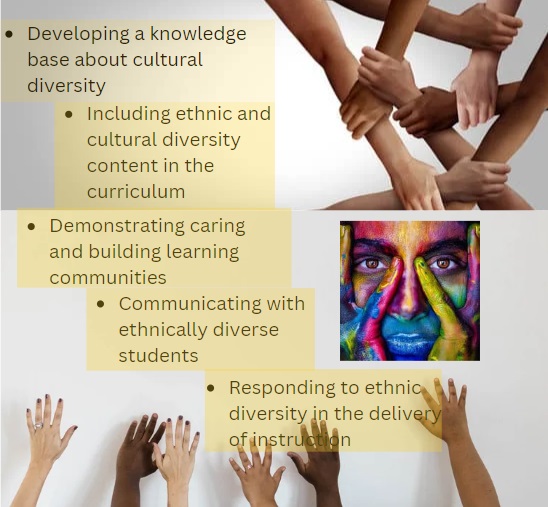
Image: Canva Pro
For educators, this can manifest in self-education, diverse reading, intentional additions to the syllabus of diverse literature, researching various cultures, and close-listening to their students.
Perhaps this is one of the reasons culturally responsive teaching dovetails so nicely with storytelling in the classroom. Sharing stories, connecting on levels that are important to the storyteller, and allowing students, especially those from different cultures than the educator can all help to build that caring learning community that Gay describes.
In the book, “Culturally Responsive Teaching: Theory, Research, and Practice,” Gay also notes that, “though ‘story’ is usually associated with people telling about themselves and/or events in which they have been involved, the explanations of educational ideas, paradigms, and proposals constitute ‘story’ as well.” Knowing this, educators can create a framework of stories in which ideas are shared and examined from multiple points of view, allowing students a space in which they can explore education in a way that makes sense to their lived experiences.
What culturally responsive teaching means to us:
When we started our program at Murray State University, we all knew we wanted to focus on social justice or equity in some way. The three of us are passionate about equity and even before this capstone project took root, we often discussed ways to bring equity into our own classrooms, including changing the way we assess student grades, learning more about multi-modality, and delving into teacher inquiry and self-reflection.
As we dug deeper into research about equity and creating safer (or braver) spaces for students in the classroom, it became clear that though the three of us diverged in the specific focus of our capstone projects, all of the work we were doing as individuals and as a group landed under the culturally responsive teaching umbrella.
We decided to pursue our interest in story-based pedagogy under the overarching theory of culturally responsive teaching. The result meant we could explore different avenues, but in all of those explorations, we had our eyes on the basic tenets of culturally responsive teaching: Creating connections with students, challenging ourselves and each other to become more knowledgeable about different cultures, and ensuring our instruction materials including classroom activities, literature, art, and slides consisted of diverse voices and images.
How to bring culturally responsive teaching into your classroom:
Creating a classroom based in equity should be a given for every educator. Students can’t learn if they are not heard and understood, and as educators, we have an obligation to give our students the best chance for success.
It can feel daunting to think about overhauling your ways of teaching, but creating a culturally responsive classroom isn’t difficult or unwelcome. Think of it as a way to create a nurturing environment for all of your students, a way to explore new ideas and to create a shared learning community where everyone has a chance to shine.
For a more in-depth discussion of culturally responsive teaching and its connection to story-based pedagogy, please listen to episode two of our podcast, “Teaching With Story.”

Image: Canva Pro
If you’re unsure where to start, consider the following:
- Keep a teacher/practitioner journal/self-reflection journal (Learn more about teacher inquiry here)
- Assess your course materials for diversity
- Assess your class readings for a wealth of different voices
- Listen to “The Danger of a Single Story” by Chimamanda Ngozi Adichie
- Read the sources listed on this page
- Understand that you may (and probably will) make mistakes and give yourself the grace to forgive them and move on.
Sources and further learning:
Some of the definitive texts on culturally responsive teaching are Culturally Responsive Teaching and The Brain: Promoting Authentic Engagement and Rigor Among Culturally and Linguistically Diverse Students by Zaretta Hammond, Culturally Responsive Teaching: Theory, Research, and Practice by Geneva Gay, and Culturally Relevant Pedagogy: Asking a Different Question by Gloria Ladson-Billings. But there are many ways to approach culturally responsive teaching and educators have written books on several aspects including culturally responsive teaching for language learners, for music educators, for college teachers, and for K-12 instruction.
Geneva Gay also breaks down some of the components of her book in the article “Preparing for Culturally Responsive Teaching.” Also, see this article on the role of arts education linked to cultural sensitivity and interculturality from the Journal for Learning Through the Arts.
Work Cited
Gay, Geneva. Culturally Responsive Teaching: Theory, Research, and Practice. 3rd ed., Teachers
College Press, 2018.
© 2023 by Mary Leoson, Finnian Burnett, & Jeffery Buckner-Rodas
 Story-Based Pedagogy