by Finnian Burnett
Using Story Based Pedagogy to Create Equity in Multi-Cultural Classrooms
From the moment we’re first aware, we absorb stories. Stories that are read to us, stories people tell us, stories we learn to tell others. People create stories about us based on what they know, and think they know about us, and we create stories to show other people who we are. In education, story can be used to create connections between students and teachers, and between the students and each other. Story is also a way of introducing the concept of defining oneself. We use story to show people the way we want to be seen which allows others to explore certain aspects of our identities – that is, we use our own story to share the experiences that are important to us.
“Without stories we would go mad. Life would lose its moorings or lose its orientations. Even in silence we are living our stories.”
Ben Okri, Birds of Heaven
Connection
Story and identity are closely related and identity span a broad spectrum of a person’s lived experience. It’s no surprise then, to find story is an important aspect of pedagogy across many frameworks and theories. In Culturally Responsive Teaching, Geneva Gay sets forth the importance of story,: “The telling of one story is the genesis of yet other stories” and further states that, “Stories also are powerful means for people to establish bridges across other factors that separate them (such as race, culture, gender, and social class).” (3). Stories build bridges; they create connections between people. They allow us to listen, and they give us voice. We are born to hear and tell stories. Narrative is part of our framework.
Stories are more than simply getting a point across. Students can thrive in finding ways to make their own stories. It gives them power in the classroom, it allows them to set their own parameters on what constitutes representation in a way that is meaningful to them, rather than a way chosen by the teacher. After all, crafting one’s own stories, even as guided by a teacher, allows students to pick what aspects of their own identity are most important to showcase. And creating stories gives students connection between their own lives and the lives of others. Mong Thi T Nygyen addresses this connection in the article, “The Digital and Story in Digital Storytelling.” Nygyen writes, “As students produced personal and meaningful stories, they drew powerful connections between how they understood the world and the world that surrounded them” (73). On the science podcast Shortwave on NPR, Liz Neeley speaks on the ways in which humans are absorbed by stories. So stories, both as told to us and as told by us are powerful tools in our searches for connection with our identity or in the way we are represented within various facets of who we are.
Stories have the power to offer recognition of one’s own culture, they give us tools for survival, and they help us build relationships with other people. But stories do more than create connections between people; they create connections between times. In this stunning essay by Matthew Salessses, the author explores retelling stories to relive time. Clearly stories are more than just words told to convey an idea. They’re a bridge, a gate, a portal. They at once lift us and ground us. Stories have power and stories give power.
As a storyteller, both in the classroom and out, I knew I wanted to create a project about storytelling. In exploring the connection between identity and storytelling, I originally planned on a research question based on the power of story and the benefits of using it in the classroom.
Can storytelling encourage self-reflection and insight in students and educators, create equity in the classroom, and lead to finding the power of one’s voice?
But this isn’t really a question. As I delved into the research, I realized that yes, of course, all of the above is true. To prove all of the above isn’t necessary because it’s already been proven time and again. But what about the practical application? If we acknowledge that all of the above is true, what can we do about it? If teachers know that storytelling creates connections with their students, that encouraging stories from students promotes equity in the classroom, challenges their own biases, and improves academics for all students, how can they use that knowledge to strengthen their own classrooms?
When Mary Leoson and Jeffery Bucker-Rodas approached me about doing a collaborative website and podcast in which we explored various aspects of storytelling and identity, I realized the main thing I wanted to do was interview people about their experiences with storytelling, both as educators and students, and share the findings with other teachers to encourage more storytelling in more classrooms. Therefore, my research question became:
How can I showcase the voices of people who may have been historically under-represented in education and share the benefits of story-based pedagogy with other educators to help them create equity in multi-cultural classrooms?
The answer, clearly, was a multi-faceted approach in which the group worked together to create this website with sections done collaboratively to show the work we’ve done together and individually to showcase our own parts of the project.
Context and Positionality
“The term positionality both describes an individual’s world view and the position they adopt about a research task and its social and political context” (Holmes 2020). In other words, everything we believe, our positions on social issues, our politics, our race, our orientation, gender, socio-economic status, all of this combines to give us a position when it comes to education and research. Holmes notes, “Some aspects of positionality are culturally ascribed or generally regarded as being fixed, for example, gender, race, skin-color, nationality. Others, such as political views, personal life-history, and experiences, are more fluid (Holmes 2020). By studying our own positionality and by finding ways to guide our students into learning about and expressing theirs, we are offering people ways to connect around their stories while lifting judgment that may naturally occur when learning of people with radically different positionality from our own. To learn more about how to bring positionality into the classroom and why, please watch this video by Mary Leoson on “Telling Stories to the Self First.”
Identity is complex and my years of studying identity and relating it to my own positionality have given me deep insight into the challenges of existing in the liminal space between not wanting to be reduced to one aspect of my identity while also being keenly aware that because that aspect is still marginalized, being seen and understood from that framework is of utmost importance.
Who am I, and why does it matter?

Story is part of my life in almost every aspect of the many facets of my identity. As a teacher, I use story to engage my students with the coursework and to allow them space to speak their own truth. As a creative writer, I use story to entertain, to bolster, to call to action. As a human, I tell stories in social situations, listen to the stories of others, create connections.
I’ve long understood the power of story in regard to my own identity and on a personal level, I use story to dive into my own investigations of aspects of my identity, such as in this creative non-fiction piece about a lifetime of being fat; this essay on body dysmorphia and non-binary identity; and this 100-word piece exploring both toxic relationships and gender fluidity.
My own positionality is closely related to how I write, how I teach, and how I hear the stories of others. In the classroom, I use positionality art and tools to help students reach into aspects of their personalities, cultures, and beliefs. In workshops, I like to explore positionality with creative writers to guide them into seeing the many intersections from which they can write their own stories. We are far more than just one or two aspects of our personal identities and while in certain situations, some might carry more weight than others, everything we know and experience makes up who we are.
Part of my take on positionality stems directly from the work I did with narrative medicine in the Northwest Narrative Medicine Facilitator Training. Mary Leoson, Jeffery Buckner-Rodas and I all took classes through this foundation and during the training, we developed new insight on trauma-informed pedagogy, empathy and connection, and culturally responsive teaching. One of the first things we did in the training was a lesson in positionality. The instructors talked us through intersections of identity and had us create art based on aspects of our own identities. Though I am no artist, the exercise of creating the art was another lesson in the many avenues of identity exploration and it helped me solidify my desire to reach outside of my own intersection to showcase other voices. A fun side note – all of us had the opportunity to share our positionality art with the Jordan Schnitzer Museum of Art which will feature our pieces alongside others from the same conference in an exhibition in June.
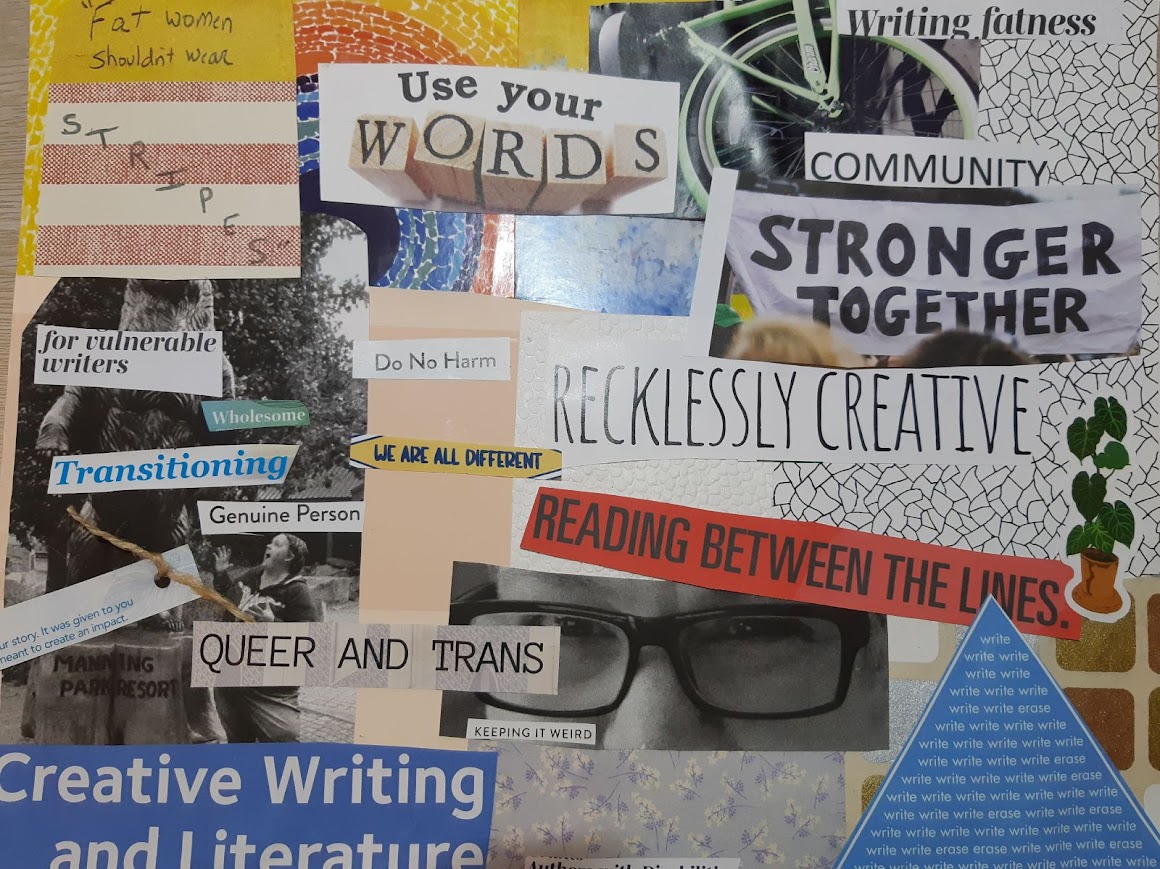
Identity is complex and my years of studying identity and relating it to my own positionality have given me deep insight into the challenges of existing in the liminal space between not wanting to be reduced to one aspect of my identity while also being keenly aware that because that aspect is still marginalized, being seen and understood from that framework is of utmost importance. In my own digital story, I talk of storytelling and survival and how finding a way to understand and accept various parts of my identity through stories was a lifesaving revelation. More, my own experience with living in a marginalized community does not refute the simple fact of my avenues of privilege, another facet of positionality. In their book, “Letting Go of Literary Whiteness,” authors Carlin Borsheim-Black and Sophia Tatiana Sarigianides note, “As white teachers, we must shoulder responsibility for interrupting racism in our classrooms, without always relying on our colleagues of color to take the lead in this work.” Interrupting racism and creating equitable learning for a multicultural student body is imperative, perhaps even mandatory for me as a white educator.
In this project, I wanted to explore not just my own experiences with storytelling and identity, but also to showcase the experiences of others and give some guidance to other educators who are interested in exploring storytelling and using it to create equity in their own classrooms.
Personal Stories and Data Collection
A major part of my data collection for this story came through conducting personal interviews and turning them into documentary-style videos about individual experiences with storytelling and identity. I interviewed four women who spoke on various aspects of identity, representation, and their experiences in higher education.
These stories and my reflection on the contents of the stories and the process in creating the videos around them can be found here.
Literature Review
The bulk of my reading took place around story and it’s relationship to story, though I also delved into story as a survival tool, story as a means of creating connection, and story as a way to shift power in the classroom. By necessity, reading on story and identity leads to culturally responsive teaching, particularly as it pertains to story. Please click below for either a PDF version or a magazine style flip book of my literature review.

Critical Storytelling for Students and Teachers
Before they can create a safer space for students, educators must do their own storytelling to challenge their own biases and find their own positionality. Critical Storytelling is one way to do this. Critical storytelling is a tool for sharing one’s academic research from the intersection of the storyteller’s identity. This leads to powerful narratives, backed by critical reading, that can expose systems of oppression based in the storyteller’s own experience. Thomas Barone sees critical storytelling as a means of sharing these injustices: “The critical educational storyteller is out to prick the consciences of readers by inviting a reexamination of the values and interests undergirding certain discourses, practices, and institutional arrangements found in today’s schools” (143).
Critical storytelling showcases social structures from a personal experience foundation. Nicholas Hartlep, et al also laud the benefits of critical storytelling, noting that people write to, “reap the rewards inherent in uncovering and revealing truths about our lived experiences that reach deeper than what is—to recognize the gaps and silences in dominant ways of knowing and seek to illuminate counternarratives.” Also importantly, for educators, narrative inquiry and critical storytelling lead to self-reflection. Diane Ketelle writes, “In narrative inquiry, stories are used to describe human experience and connect us with others” All of this comes back to the educator’s positionality or the intersection of identity, cultural status, socio-economic status, abilities, education, etc that leads to who they are.
Critical Storytelling is, in the simplest terms, telling one’s personal narratives backed by academic research. In this video, I explain the basic ideas of critical storytelling, share ideas on bringing critical storytelling into the classroom, express the importance of educators using critical storytelling themselves, and offer ideas for further research on the subject.
Teacher Inquiry
Teacher inquiry is a necessary component of an educator’s teaching plan. To learn about the definition and benefits of teacher inquiry, and to see an infographic on how to get started or hone your own reflective teaching practice, click above.
Conclusion
My goal with this project was to amplify the voices of others, share personal experiences of people from different cultures and backgrounds, explore the positive benefits of bringing story-based teaching into the classroom, and showcase the need for educators to engage in ongoing self-reflection and bias-awareness.
I also wanted to give a general overview of key concepts such as critical storytelling, teacher inquiry, and culturally responsive teaching and a more in-depth examination of story as identity, as survival, as communication, and as connection. I also wanted to share information on getting started using teacher inquiry and critical storytelling so educators interested in using story based pedagogy in their classrooms could start today. The bulk of my individual section of this project did all of that. Through the personal stories documentaries, my own lit review, and my own personal story, I explored the idea of story as identity and the importance of representation. By reading through these sections, I hope to help educators recognize the importance of using story based pedagogy and the imperative of creating culturally responsive classrooms.
What I didn’t expect was how much richer and in-depth the shared sections of this project would become in working in tandem with Mary Leoson and Jeffery Buckner-Rodas. Our reviews and discussions of each other’s digital stories, our combined efforts in creating information about the power of story, culturally responsive teaching, narrative medicine, and multi-modality and our joint research into equity and social justice led to deep conversation about all of the topics, much of which filtered into our shared podcast.
The shared survey we created and sent to participants offered insight across various levels of education and on how different educators use story in their classrooms, work to empower students, and use multi-modality in their classroom. The complete list of survey questions can be found on our home page.
If you’re an educator with more questions about bringing story into the classroom, please feel free to reach out to any of us. If you want to connect directly with me, you can find me at finnburnett70@gmail.com or through my website http://www.finnburnett.com
For an interactive discussion about identity and its connection to story-based pedagogy, please listen to episode two of our podcast, “Teaching With Story.”
Sources for this section
© 2023 by Mary Leoson, Finnian Burnett, & Jeffery Buckner-Rodas
 Story-Based Pedagogy